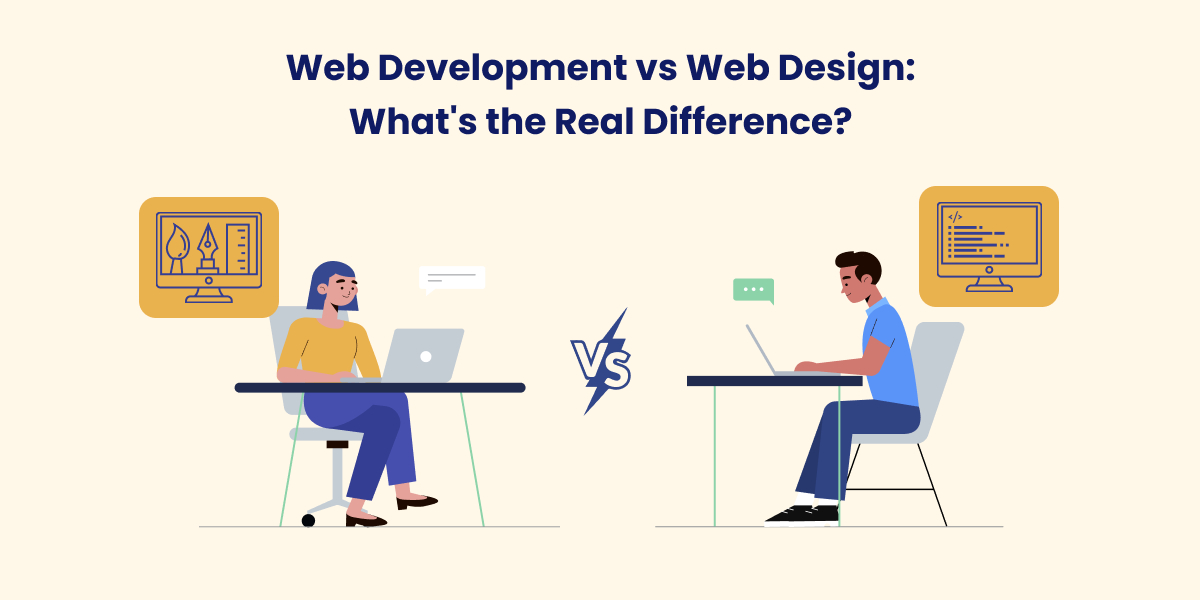
Introduction
In the process of developing a website, two of the most important professions are applied, i.e., web development and web design. As much as they go hand in hand with each other, they have different purposes to serve. Businesses, startups, and those on their way to achieving a great online presence should learn the basics of their differences.
This post is going to examine the duties, the tools, the objectives of web developers and designers, and how the two can be used to create fun, functional websites.
What is Web Design?
Web design is known as the visual appearance and user experience of a website, with the primary focus on the aesthetics and overall feel designed by designers. They concentrate on designs, colour schemes, typography, and the general ease of use.
Core Tasks of a Web Designer
- Selection of colors, fonts, and graphics
- Layout and user navigational design
- Visual consistency in devices
Tools Used by Web Designers
- Adobe XD
- Figma
- Sketch
- Canva
Key Goals
- Visual appeal
- Easy-to-use experience
- Brand alignment
An excellent web designer is one who knows the user psychology, the brand voice, and emotional bonding. The visual impression has a vital factor in making or breaking the stay or bounce of the modern user, as they judge a site within seconds.
Website Designers, hence, do not just work on the appearance of the site but also the feel, which takes the user to the following action in a flow. It is this emotional and visual storytelling that makes brands memorable on the internet.
Web design is not creativity nowadays, but is supported by UX research, wireframes, prototyping, user behaviour analysis, accessibility standards, and mobile-first mentality. The work of a designer makes sure that there are not only beautiful websites, but also meaningful and easy to experience.
What is Web Development?
Web development implementation is carried out by its developers through code. They facilitate the work process between the site and ensure it runs effectively.
Responsibilities of a Web Developer
- Coding (HTML, CSS, JavaScript, and so on)
- Database and server management
- Adherence to site speed and security
Tools Used by Web Developers
- Visual Studio Code
- Git/GitHub
- React, Angular, Node.js
- WordPress, Drupal
Key Goals
- Functional performance
- Quick loading speeds of the pages
- Backend integration
- Cross-browser compatibility
The web developers make ideas come true. All the things that users click, experience, submit, or interact with are made possible through development. Stability and intelligence, behind every online move, are guaranteed through the development of systems that include login systems and dashboards, to booking and e-commerce engines. An established site is safe, can be scaled up, is fast, and is able to support real-world traffic without collapsing.
Another essential task that developers perform is to secure websites with security measures, GDPR, server performance, and performance optimization, as cyber threats and user demands keep developing. Even the most appropriate design is not going to work without the development of the experts.
Web design influences the imagination, whereas web development executes it. One is the communicator of images and the other the communicator of technology. They combine to deliver smooth online experiences that consumers enjoy and that companies depend on. Knowing this distinction also avoids confusion during the process of recruiting teams or budget preparation for online projects.
Why Understanding the Difference Matters for Your Business
When building a website, choosing the right talent matters. If you want a visually stunning site, you need a designer. If you want that design to work seamlessly, you need a developer.
Making the Right Hire
- Need a new layout? Hire a web designer.
- Need custom functionality? Hire a web developer.
Most businesses fail as they have to handle the same professional with both roles, and thus give them a site that looks good but does not work, or one that is technologically correct but not attractive looking. The realization of the difference assists the businesses in allocating resources in a better manner, enhances the project efficiency, and attains greater ROI.
Why Web Design Matters More Than Ever
- First impressions are entirely based on design; the user would decide in a few seconds whether they are going to trust your site or not.
- High visual hierarchy, brand equity, and user-friendly structure will create credibility immediately.
- Good design is not only about appearance, but it also assists users in moving freely without having to get lost.
- With a design that is easy to use, the users will remain longer, interact, and close more.
Why Web Development Is Critical for Business Success
- The most beautiful webpage does not work without good coding and technical stability under it.
- Web development makes sure that the pages load quickly, the database works quickly and without failure, and features do not cause any problems.
- Security is another issue developers manage, making sure that the data of the users is safe and in line.
- Good development ensures scalability in the long term, and therefore, your site will scale as your business scales.
The Importance of Combining Web Design and Development in 2025
The digital climate has experienced dramatic transformations over the last few years, and 2025 is not an exception. Customers no longer settle for websites that are merely good-looking or fast-loading; they require an end-to-end digital experience. That is why businesses must consider design and development as a shared investment rather than two separate processes.
One that has good aesthetic potential but less-than-optimum functioning will annoy users, and equally, the technically sound site with a plain design will not attract attention. Businesses require both to shine.
Digital success today is achieved through conversion-oriented design or performance-based development. The websites are supposed to serve as selling tools, information centres, customer handling, and brand experiences at the same time. Strategic integration between design and development helps businesses to enjoy enhanced engagement, confidence, and revenue potential.
User Experience - Where Design and Development Meet
- UX is a balance between creativity and technology where the user enjoys their overall browsing experience.
- Designers organize the intuitive navigation, and developers guarantee an instant response to the interaction.
- Together, they remove frustration, delays when loading, and confusing interfaces.
- The result of this harmony is increased engagement, customer satisfaction, and improved retention.
Responsive & Mobile-First Approach
- The majority of users browse using smartphones, hence mobile performance has become a priority.
- Designers develop layouts that become graceful and do not lose their beauty when reduced to small screens.
- The developers also make sure that the code is responsive to provide a similar experience on all devices.
- A well-translated mobile site translates to higher conversions, higher SEO, and confidence in the users.
The advantages of performance optimization
- Time is of the essence - websites that run slowly lose business and customers overnight.
- The developers optimize images, scripts, servers, and databases to deliver blistering performance.
- The designers aid the speed by keeping the layouts light.
- Combined, they create a site that can load fast, rank higher, and make the users happy.
Real-World Examples of Design and Development in Action
Consider your top online store. The design is what attracts you, the colors, the layout, and the simplifications of navigating the site. Yet, the explanation for why you continue shopping is the functionality, the fast checkout, mobile friendliness, and secure payment method.
This balance is precisely what companies deliver: design that excites users and development that powers reliability.
Consider websites such as Amazon, Airbnb, and Netflix; all of them are evidence of excellent design combined with exceptional engineering. Their success tales confirm that none of the disciplines is effective to work alone. The companies that have implemented this philosophy have higher customer retention and sustainable digital expansion.
Accessibility and Inclusivity
- Accessible design guarantees the usability of websites even among users with disabilities.
- Designers are concerned about color contrast, legible fonts, and organized content designs.
- Developers add assistive tags, compatibility, and semantic coding.
- This enhances usability as well as brand trust and legality.
SEO Benefits of Good Design and Building
- Designers assist in organizing content in a more appealing way that would aid in enhancing readability and interaction.
- Technical SEO, such as schema, clean code, and structured data, is done by developers.
- They combined to help boost ranking potential, organic traffic, and discoverability.
- The one built with SEO consideration is more successful in the long run.
Why Businesses Should Care About the Difference
- Increased ROI- When one invests in both areas, they will have a higher conversion rate and fewer bounces.
- Brand Image - Design is a reflection of professionalism, whereas the development instills credibility.
- Growth in the future - a well-designed, well-developed website is more scalable as your business increases.
- Customer Trust - The secure coding practices and sound design will both play a role in gaining the confidence of your audience.
Learning about such differences also facilitates more innovative budgeting, more realistic planning, and improved collaboration of teams. Companies that value both functions in their business enjoy an easier delivery of projects, enhanced digital branding, and more quantifiable success.
Security & Reliability
- Cyber threats are present in modern websites, and hence, secure development is required.
- The developers are using encryption, firewalls, secure coding, and constant monitoring.
- Design is also a factor in that it directs the interaction between the user and safety, as well as open trust signals.
- Safety sites generate trust and safeguard brand image.
The importance of Continuous Support and Updates
- A site is never complete; it requires constant development to remain relevant.
- Designers will update the images to keep up with the trends and evolving user behavior.
- Developers uphold performance, eliminate bugs, improve security, and technology.
- Ongoing partnership makes the site powerful, updated, and competitive.
The Role of Full-Service Agencies
Designers and developers are costly to hire for a small company or a startup. You do not start coordinating various freelancers; instead, you have one team to handle design and development effortlessly.
Whether designing layouts during brainstorming or writing complicated functions, one partner will mean consistency, speed of delivery, and a common strategy.
The agencies that are full-service are also guaranteed of good flow in communication, minimized mismanagement, strategic planning, combined creativity, and technical perfection, all under the same roof. This not only saves business time and money but also guarantees predictable outcomes.
Individualized Experience and Network Effects
- The users of today would want a customized experience rather than generic browsing.
- Layouts are created by designers in ways that allow customization of personalized elements.
- The developers combine the intelligent systems and automation to provide customized content.
- It results in more engagement, high conversions, and loyalty.
Business Benefits of Knowing the Difference
- Knowledge is specific enough to guide the firms in recruiting the appropriate specialists.
- When roles, responsibilities, and expectations are outlined, projects are carried out smoothly.
- This saves time, minimizes cost, and reduces miscommunication.
- In the end, it results in an improved performance of digital solutions.
Looking Ahead: The Future of Web Design and Development
Technology is developing, and web design and web development are becoming increasingly closer. The use of AI-enabled technologies is already impacting how designers perform mockups, and low-code/no-code platforms are making it easier to achieve developmental outcomes. However, even on this basis, the requirement of skilled professionals is not going away, as the real innovation occurs where design creativity and development proficiency meet.
Immersive experiences, personalization, automation, and more brilliant interaction design will remain a prominent feature in the future. Companies that invest today in a robust web design and development base will be ahead of the others tomorrow.
A Future In Which Design and Development Become Stronger
- These are roles that are getting increasingly closer due to technology trends.
- AI, automation, and advanced frameworks demand both creativity and technical strength.
- Companies investing in design as well as development will have ready digital platforms in the future.
- This has been a combination that delivers robust, scalable, engaging, and high-performing websites.
Why Continuous Collaboration is the Key
Permanent cooperation between designers and developers is another noteworthy aspect that business owners often overlook. A site is never finally completed; trends evolve, user habits change, and technology advances. Once design and development teams cooperate after the launch period, they can enhance the site's performance and implement new design changes.
Ongoing cooperation also helps to optimize, interpret analytics better, refresh UI constantly, and increase user satisfaction. The current websites are living beings; they are changing, developing, and adapting in accordance with user requirements.
User Experience as a Business Advantage
In the current competitive digital world, user experience (UX) makes the difference whether a visitor would prefer to stick to the site or exit it. Good design is appealing, and good development is characterized by fast loading, easy navigation, and secure transactions.
When the two are combined, not only do they improve customer satisfaction for businesses, but they also gain a tangible advantage in conversion rates and customer loyalty over the long term.
Companies with a focus on UX are always ahead of their rivals in terms of engagement, trust, and long-term development. The good site is no longer an option, but a business necessity.
Conclusion
Web design and web development go hand in hand; one shapes the look and feel, while the other builds the structure behind it. Knowledge of the two would enable businesses to make smarter hiring decisions and create websites that encourage users and drive growth.