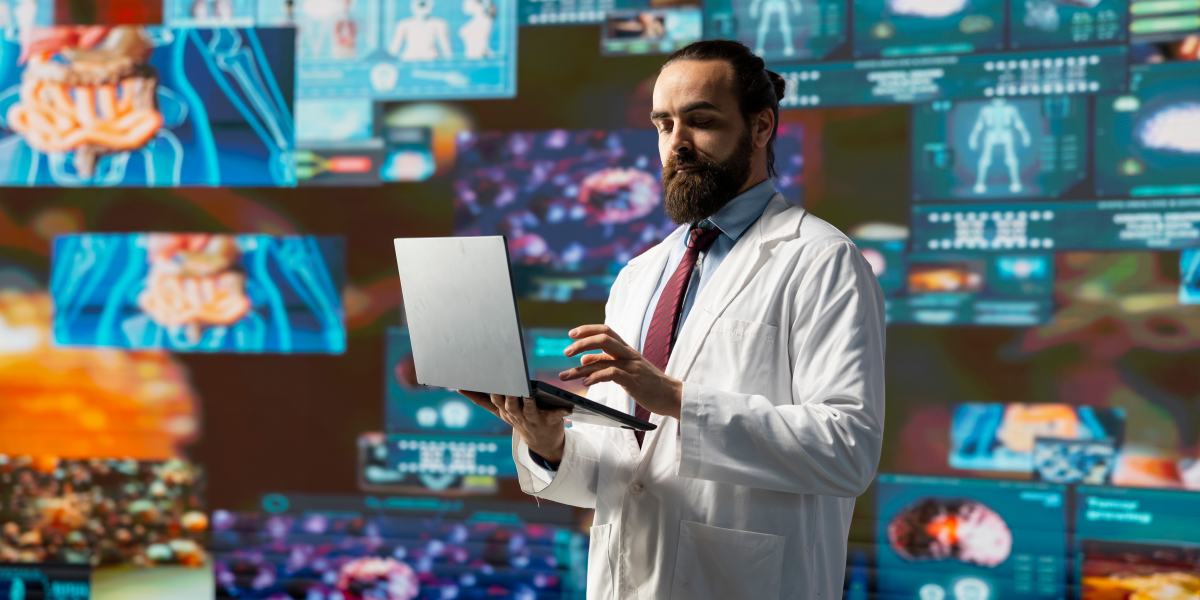
Healthcare technology is frequently associated with high-tech medical devices, artificial intelligence, and digital health applications. Yet in day-to-day operations, healthcare technology can be very simple – for example, when a nurse accesses a patient’s drug history; when a physician reviews diagnostic testing results prior to seeing a patient; or when a patient attends a follow-up consultation with no travel required to attend the clinic.
These examples show how technology in health care can actually be used. Technology can help people gather, comprehend, exchange and use data that supports the provision of health care. There are several different ways in which technology can help support health care. One way is to help providers diagnose and treat patients. Another way is to help providers reduce their administrative burden. A third way is to help providers communicate better with one another. And lastly, technology can help provide access to services more easily for consumers.
The advantages may be significant, however technology by itself cannot ensure superior healthcare. Technology systems need to integrate into clinician's work processes, safeguard confidential data, interact with other systems already in place, and be user-friendly for individuals with varying levels of ability.
Healthcare providers, business leaders, and technology teams can use their knowledge of both the opportunities and constraints when making better informed decisions regarding digital investments.
What Is Healthcare Technology?
Healthcare Technology is defined as the digital systems, medical devices, software applications, and technical procedures utilized to provide care for patients, manage operations, conduct research, and engage with patients.
This includes a variety of tools. An electronic health record (EHR) contains the patient's medical records, a tele-health platform connects the patient and doctor electronically, and a wearable device can track physiological measurements like heart rate or physical activity. In addition to the obvious applications, there are also databases, communication networks, security measures and integration capabilities used to transfer data from one system to another.
Health care technology has application beyond hospital walls. It also is used by primary care practices, diagnostic lab, pharmacies, insurance companies, public health agencies and patients themselves.
The way that it functions depends upon where it is being used. For example, a hospital may use digital systems for coordinating admissions and discharges. A community clinic may send out reminders about appointments to help prevent patients from missing their appointments. A person who has a chronic disease can take measurements of their vitals with a connected device in-between doctor's appointments.
The overall goal of all these systems is to provide reliable information and practical solutions for healthcare professionals to complete their work. However, the effectiveness of any one system in achieving this goal will depend upon how effective it was designed, implemented, maintained, and utilized.
Major Applications of Healthcare Technology
Electronic Health Records
The term electronic health records (EHRs) refers to an electronic system that stores and organizes a person's medical data in a digital format. An individual's EHR may contain a variety of data, including their medical history, diagnosis, allergies, prescribed medications, laboratory test results, physician's notes, and proposed treatment plan; the specific types of data contained within each individual's EHR depends upon how the EHR was configured.
In addition to viewing the results of prior tests and the medications that are currently prescribed for the patient, two providers, such as a primary care doctor and a specialist, can view each other's documentation if they each have authorized access to the patient's records. This will allow the providers to share a common understanding of the patient's health status and needs.
This will allow for better informed consultations, as well as decrease the need for double-entry of information. It could also assist admin teams with the management of paperwork and coordination of post-visit care.
However, a digital health record is only as helpful as the content within it. Errors in entry, old prescriptions, incomplete medical history and/or inconsistencies with how items have been coded will all lead to confusion. Therefore, the use of access control measures, ongoing training for employees, established guidelines for documenting patient care and frequent review of the quality of the data entered into the system are necessary.
Telehealth and Virtual Consultations
The use of telecommunications technology allows for remote delivery of some health care services. This may include using video consultation, secure messaging, providing remote follow up care and delivering digital patient education.
A virtual visit can lower the amount of time that a patient has to spend on traveling if they live far away from their specialty provider. A virtual visit can also make it easier for a patient to receive follow-up care. A virtual visit can also allow a doctor to evaluate a patient's symptoms or discuss the status of a patient's treatment when an in-person evaluation is not required.
Telehealth isn’t always the best option. Patients who have a serious medical problem that requires an examination, tests, or emergency treatment will probably benefit more if they are seen face-to-face. Other barriers to using telehealth effectively include inadequate internet connection, limited ability to use computers, and a lack of privacy.
Healthcare providers need to identify which types of consultations may be performed using remote methods, describe the conditions under which patient visits must take place in person, and develop alternative options that are accessible to patients who cannot access healthcare services through digital means.
Remote Patient Monitoring
Remote patient monitoring utilizes connected devices and digital platforms to gather health metrics from patients while they are in non-clinical environments. The type of metric(s) collected will depend upon the specific device used. Examples of metrics that can be gathered using remote patient monitoring include blood pressure, blood glucose levels, heart rates, oxygen saturation levels, and body weights.
A care team that supports a patient with a chronic disease may request the patient to take blood pressure measurements at home. These measurements are sent to a remote monitoring system, which enables authorized personnel to assess the readings based upon the established care plan.
This method will provide clinicians with more data between patient visits. Additionally, it could allow for identifying changes that require immediate attention (follow-up) if the monitoring system incorporates suitable thresholds, review protocols, and procedures for escalating concerns.
Collecting data is different than delivering care. There are several reasons why this could occur; such as: inaccurate reading, lost connection to the device, or missed alerts due to no clear definition of responsibilities regarding monitoring. Organizations will have to establish who is responsible for reviewing incoming data, how long that person has to review that data and what actions are acceptable if the data exceeds normal parameters.
Healthcare Data Interoperability
Interoperability of healthcare data refers to how different systems can share and utilize the same information productively.
The hospital, laboratory, pharmacy and specialized medical practices each can utilize a different type of software platform. If there is no proper integration, staff will likely have to enter data more than once into different systems; look up information in many different systems; or allow patients to bring their own paperwork with them from one appointment to another.
Interoperability will help overcome some of the above-mentioned problems by providing a means of communication between various systems using consistent, secure methods of data transfer. Standards such as HL7 FHIR offer a formal framework to represent and transmit healthcare data using well-defined resources and interfaces.
However, linking two systems is seldom solely a technical endeavor. Organizations are required to reach an understanding regarding data definitions, identifying patients across both systems, authorizing access, managing errors, and assigning accountability for correcting inaccurate information.
A successful interface for transferring data can still result in misinterpretations of data if the receiving system has a different interpretation of a particular field. Therefore, achieving an effective interoperability environment will require technical standards, governance, testing, and continuous monitoring.
Administrative Automation
Healthcare providers perform many administrative functions such as making appointments with patients; registering new patients; creating bills for services provided to patients; checking if patients have health insurance coverage and what type of coverage they have; managing documents created during the process of providing care to patients; communicating with patients about their care.
Custom healthcare software development enables automation of predictable, routine work. For example, a scheduling system could generate automated reminders for appointments. A workflow application would allow us to automatically route incoming documents to the correct department. Billing software would identify any missing information on a claim prior to submission.
The use of these applications can help to decrease the amount of manual work involved in healthcare delivery, as well as provide a more efficient method of tracking process. Additionally, the time saved through the use of such applications could be utilized by staff to complete other tasks which require human decision making and/or direct interaction with patients.
Automation does not merely increase the velocity of a bad process. When there are flaws in the logic (rules) or gaps in the data (information) that defines the work flow, automation will amplify those deficiencies across the company.
Teams need to record their current process, find the exceptions to that process, and run tests on the automated decision-making system prior to putting it into action. There must be clearly defined steps in place for review by humans when a case is sensitive or has significant implications.
Patient Portals and Digital Health Services
Patient portals provide a way for individuals to interact with their healthcare provider using a secure, electronic interface. Depending upon the portal used, an individual may be able to view certain parts of his/her medical records, schedule appointments, review the outcome of tests, manage medications, complete forms and/or communicate with members of his/her care team.
These services are able to simplify day-to-day communications between patients and healthcare providers. They can provide an alternative to telephoning a doctor's office, and/or providing physical copies of paperwork. Additionally, they can provide patients with access to pertinent data prior to their appointment so that they can be prepared.
Good design is important. Medical language can be confusing, and an unclear user interface can cause people to not use a service. Also, patients may have limited access to the internet, physical limitations, language preferences, or concern regarding their privacy when providing personal data over the web.
Digital access can be a barrier to care if it's designed inaccessible, has confusing explanations, isn't mobile-friendly, or has limited options for people who can't use digital services.
The healthcare app development company directory is a resource for those looking at various types of digital healthcare products and development methods, as well as providing a reference point for examining the wide variety of companies that are involved in this area.
Artificial Intelligence and Clinical Decision Support
The use of artificial intelligence in healthcare-related areas is expanding. These include the use of AI to analyze medical images, provide documentation support for clinicians, predict operational outcomes, and develop decision support systems.
An AI-driven system can help with the organization of clinical notes and/or identification of trends within a specified data set. In addition, an AI-powered medical imaging device can provide qualified practitioners with areas that need to be evaluated further.
These abilities need to be seen in the light of several factors. A model's success will depend upon how representative and well-suited the data is, the specific job the model has been developed for, and where the model will be applied.
The AI-produced data can also be partial, incorrect, or deceptive. As a result, clinical decision-support systems should undergo evaluation for the intended purpose, validation through adequate research evidence, continuous monitoring post-implementation, and have sufficient human supervision.
What Are the Main Benefits of Healthcare Technology?
Healthcare technology can be valuable from a variety of perspectives: clinical, administrative, and patient-related.
1) Increasing Accessibility of Services
Modern technology can be used to create a more accessible environment for the target population. Using virtual means, patients who have a need for recurring aftercare can visit the facility and have a consultation without the challenge of commuting. Moreover, such technology is helpful when the medical service is under the remote location or the patient has limited mobility.
2) Increasing Access to Information
The availability of information will be improved if patients’ data is provided to the authorized personnel in an easily accessible way. This feature can be especially beneficial for clinicians, as they will be able to learn about the patient’s history in a more structured and timely manner prior to the visit.
3) Reducing Clerical Hassles
The use of technology by the facility administration can reduce clerical hassles for the staff. With more organized and structured data, the administrative staff will have more time and energy to focus on the patients and the critical issues. Additionally, the implementation of a planning tool that helps manage schedules and reminds about upcoming visits will reduce the burden associated with paperwork.
4) Increasing Patient Involvement and Awareness
As a part of modern technology, electronic health records can help increase patient involvement and awareness. They can provide the target population with easy access to the records, schedule, relevant resources, and communication tools. With clear directions and data, patients will be able to prepare more meaningful questions and topics to discuss with the clinicians.
5) Enhancing Managerial and Organizational Oversight
The technology can assist the administrative and managerial staff in oversight and control. This will be achieved through the collection of data and presenting it in a more organized manner. In such a case, the manager will be able to locate problem zones and make necessary adjustments.
Challenges and Risks to Consider
Privacy and Cybersecurity
Healthcare information can include highly sensitive personal details. A compromised account, exposed database, or misconfigured cloud service may create serious consequences for patients and providers.
Interoperability and Legacy Systems
Healthcare providers may depend on older applications that are costly or difficult to replace. Connecting them to newer platforms can require data mapping, interface development, migration planning, and extensive testing.
Data Quality and Reliability
Digital systems can make inaccurate information available more quickly if validation and correction processes are weak. Duplicate patient records, missing fields, incorrect units, and delayed updates can affect both operations and clinical interpretation.
Usability, Accessibility, and Staff Adoption
A technically capable system may fail in practice if it adds unnecessary steps or does not reflect the way people work. Staff may develop workarounds, enter incomplete information, or avoid features that are difficult to use.
Cost and Long-Term Maintenance
The cost of a healthcare technology project extends beyond its initial development or purchase. Organizations may need to budget for integrations, hosting, security reviews, staff training, software updates, support, and future changes to operational or regulatory requirements.
How to Implement Healthcare Technology Successfully
Define the problem first. Identify the specific challenge, such as repeated data entry, missed appointments, slow access to test results, or limited visibility into remote measurements. Establish a baseline so the team can evaluate whether the solution makes a meaningful difference.- Involve the people who will use the system. Consult clinicians, administrators, IT teams, compliance specialists, and patients where appropriate. Their input helps uncover workflow requirements and accessibility needs that may not be visible to project sponsors.
- Map data and integration requirements. Determine which systems must exchange information, which data is essential, who can access it, and how errors will be handled. Plan for identity matching, migration, testing, and recovery before implementation.
- Assess security and applicable obligations. Identify the information being processed, likely threats, access requirements, vendor responsibilities, and relevant legal or regulatory obligations. Make security part of design and testing rather than a final checkpoint.
- Test in realistic conditions. Evaluate usability, performance, security, integration accuracy, and failure scenarios. A pilot involving a defined group or workflow can reveal practical problems before broader deployment, provided that appropriate safeguards are in place.
- Train users and monitor results. Explain how the system fits into daily work and where users should report problems. Track relevant indicators, review feedback, resolve defects, and adjust workflows when evidence shows that changes are needed.
How Should Organizations Measure Success?
Success should be measured against the original problem, not the number of features released or the fact that a platform is now digital.
Useful indicators may include:
- Access: appointment availability, waiting time, or completion rates for digital services.
- Operational efficiency: time spent on repetitive tasks, duplicate data entry, or administrative processing.
- Data quality: missing fields, duplicate records, and integration errors.
- Reliability: system availability, unresolved incidents, and recovery performance.
- User experience: task completion, patient feedback, staff satisfaction, and accessibility issues.
- Safety and governance: access-control exceptions, security incidents, and completion of required reviews.
What Is the Future of Healthcare Technology?
Healthcare technology is likely to continue developing through more connected systems, better remote-care tools, greater use of automation. Wearable devices and connected medical equipment may provide additional information outside clinical settings, while interoperability initiatives may make it easier to exchange data across organizations.
The most useful innovations will not necessarily be the most complex. Sometimes the greatest improvement comes from making an existing process clearer, removing an unnecessary handoff, or ensuring that the right information reaches the right person at the right time.
Conclusion
Healthcare technology includes far more than medical devices and advanced algorithms. It encompasses the software, connected systems, and digital processes that support patient care, communication, administration, and informed decision-making.
EHRs, telehealth, remote monitoring, interoperability, and AI each offer distinct opportunities. They also introduce responsibilities involving privacy, data quality, security, accessibility, and human oversight.