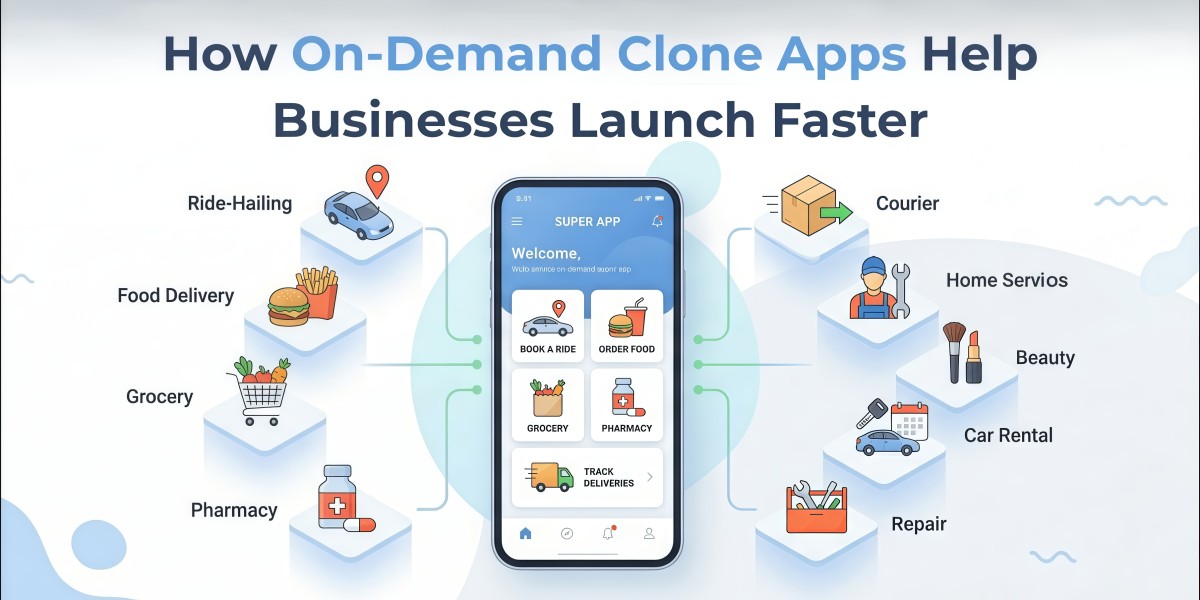
Introduction Product Launching in moments is the New Crazy in the Digital World. The on-demand clone apps have become the next game-changing solution that helps companies to hit the market at a lightning-fast speed by allowing them to pre-build features and customizable templates. It saves on development hours and costs and on the risk of a new launch. As more entrepreneurs latch onto the fact of how clone apps hold potential, for entrepreneurs looking to gain an edge in their respective industries, understanding the advantages of clone apps, customization capabilities, and the challenges involved in implementing them is crucial.
Understanding On-Demand Clone Apps
Definition and Overview
On-demand clone apps are almost similar to existing applications that have a specific need. These apps replicate popular platforms (think Uber or Airbnb) so businesses can enter the fray without having to reinvent the wheel. They’re like templates for success, prepared to be adapted and gotten off the ground fairly easily.
How Clone Apps Work
Even more, clone apps require 3rd party applications or a release version of the app already running in the market by using it as a reference. So, it is like having a cheat sheet for your exams. Everyone gets all the right answers served on a platter! A business can adopt a validated model and apply changes that align with their own brand or needs, helping them not seem like just another app in the throng.
How They Differ from Traditional App Development
Building out applications the traditional way can feel a lot like building a space shuttle from scratch—long and fraught with delays. On-demand clone apps, however, are like IKEA furniture; they have a clear structure, and while you may need to spend some time and energy on this, you won’t be reinventing the wheel. With clone apps, you have a jumpstart so that instead of asking man’s most important questions (i.e., what to do first), you can start customizing and scaling.
Key Benefits of Using App development background
Cost-Effectiveness
Cost-efficient. One of the biggest advantages of clone apps is that they cost a lot less than a platform developed from scratch. Building an app from scratch can be like attempting to cook a five-course dinner with just a microwave. Clone apps reduce hours and costs of development, freeing up cash for businesses to focus elsewhere — on midnight snacks (or marketing, y’know).
Faster Time to Market
In the world of tech, timing is key. Clone apps speed up the launch process so that businesses can get started on taking the scenic route directly or not. With an off-the-shelf base, companies can deploy their services in a matter of weeks and begin getting users while competitors are still deciding the color palette in which to paint their app.
Reduced Development Risks
Using clone apps also means you’re not sailing to uncharted waters without a map. Because these apps are based on models that are already proven, there is less uncertainty for businesses. It’s like being given a GPS on a road trip. You may hit some bumps, but you are not getting lost for sure!
Speeding Up the Launch Process with Clone Apps
Rapid Prototyping and User Testing
It is as easy (and rewarding) to rapidly prototype with clone apps. By researching and creating a working model, businesses can get user feedback much faster. With this iterative approach, they can continue to refine features until everything feels perfect—no more awkward second-guessing at the launch party!
Streamlined Development Cycles
You get shorter development cycles since clone apps are a sprint instead of a marathon. It allows teams to hone in on what the experience is, rather than starting from zero, having fewer meetings, and doing more building. All about cutting to the good stuff!
The Role of Modular Architecture
Modular architecture is the icing in terms of the flexibility offered by clone apps. Just as LEGO bricks let you construct whatever your brain can dream up, modular architecture allows for plugging and playing various features as you grow. Looking To Add A Loyalty Program? Go for it. Need an analytics dashboard? Done! You can iterate and evolve your app without having to rip everything apart and start over.
Customization and Scalability in Clone App Solutions
Tailoring Features to Business Needs
Not all clone apps have to be based on templates just because they begin this way. Approximate a tailor-made suit—Businesses can customize features based on individual needs, so businesses distinguish themselves from the App Store fashion show. Be it an unconventional payment integration or a quirky UI, the customization defines any app.
Branding and UI/UX Adjustments
Just because you’re using an on-demand clone app does not mean you need to start looking like a clone! With branding and UI/UX alterations, companies can put their unique imprint on the app. Whether it is logo placement, color schemes, personalized icons, or navigation layout, the options are endless. This guarantees that although your app might offer similar features to other clones out there, the look and feel of your application would be completely yours, as nobody wants to drive a car that looks identical to everyone else’s at the end of the day!
Scaling with Demand
Finally, On-demand clone apps are scalable with your business. And when demand spikes, these apps can ramp up to accommodate an influx—easily. It’s like a customizable wardrobe. It allows you to add new pieces, as required, without having to spend a small amount on brand-new outfits. So whether you are handling a flood or a trickle of users, your clone app has got your back!
Cost Considerations of On-Demand Clone Solutions
Lower Development Costs
Let’s be honest — building an app can quickly become a wallet drainer. Clone apps reduce the costs significantly because they use already available frameworks and require less coding. It’s similar to a hack you just found that allows you to save money on your business. The benefits are there for nothing, without the high price that is normally included in traditional development.
Budgeting for in-progress Maintenance
While clone apps seem way cheaper at the initial stage, it’s better to have your budget for maintenance in place. Routine maintenance and bug fixing, as well as addressing user feedback, are all very standard fare. Consider it a gym membership. We don't see the effects immediately, but when you start to work hard every day, then surely you will be fit.
Challenges and Considerations When Choosing Clone Apps
Choosing the Right Clone App Provider
Selecting a clone app provider is like selecting a dance partner for prom. You need someone who will always make you move and knows your pace! Not all providers are the same, so you’ll want to do some deep digging. Seek out providers with a killer portfolio and glowing reviews—and make sure their apps can scale, because no one wants a dance partner who can’t hang when the beat drops. Inquire whether they provide tech support because the right support at a crucial time can convert potential fiascos to smooth moves on the stage of business!
Legal and Compliance Issues
Imagine the legal landscape of clone apps. You have to feel like you are walking through a ghostly house, full of danger and surprises! Be very careful not to step on anybody’s copyright or trademark toes. Check that the clone app you are interested in follows local regulations and data protection laws. While this may sound insignificant, neglecting these aspects can transform an otherwise promising opportunity into a legal nightmare — not the experience anyone wants to have. Educate yourself, do your research, and make sure that your business is set to shine within the law!
Addressing Technical Limitations
Not everything that shines is gold, as are clone apps. Technical limitations, such as scalability problems or binding of third-party APIs. However, Agile development practices, if implemented along with backend infrastructure, can enable the team to reduce bumps on this road towards your app launch. Cloud technology also provides a way to address storage and performance challenges, making it easier to deal with user traffic without breaking a sweat (and your wallet).
Navigating Market Competition
It is an app store/marketplace feature. It’s just like a bad flea market or a yard sale—there is so much to find, but so much horrible stuff. In order to succeed, clone apps need to provide a new value proposition as compared with their existing counterparts. That might be exclusive features or tackling niche demographics. In addition, your secret spice could be investing in brand identity and community engagement. And remember, your objective isn’t just to enter the race—you want to win it in style!
Case Studies: Successful Implementations of Clone Apps
Industry-Specific Examples
So let’s take a quick turnaround through some of the success stories! As an illustration, a food delivery service entry in the market used its cloned app within a few hours to tweak its features, supporting local taste buds and requirements for delivery. Likewise, a ride-sharing service copied an existing app that was proven successful yet presented original user-focused incentives for users to download the app, exploiting the gained ground. As these examples are from various industries, there will be a necessity for choosing clones targeted to local customer needs, since nothing can beat a hot, piping pizza being delivered in record time.
Lessons Learned from Failed Launches
Not all of them have happy-ever-after app launches—some are more like an episode from a bad rom-com. For example, an e-commerce business based in a certain locality rolled out a clone app without customization, and none of the audience tended to use it. Another firm rushed and skipped user testing and quickly found that their app's tab navigation had users feeling like they were on a surprise detour! The key takeaway? Launching a clone without adequate tweaking and testing is akin to bringing a flat tire to the big day—best of luck with that!
The Strategic Advantage of Clone Apps
Summarizing Benefits
In a nutshell, clone apps provide a smorgasbord of benefits for businesses willing to hit the ground running. And come with a battle-tested framework that enables them to save development time and reduce costs, providing entrepreneurs the needed time to be innovative instead of coding from scratch. As a result of their rapid deployment, lower risk, and customizable features, the two cloud services offered by both providers provide an appealing option for startups as well as established businesses.
Final Thoughts on Business Growth
Flexible Simplicity in the App Development World-Clone Apps. By having existing models to build on, all the while injecting some of their personality into what is out there, not only can entrepreneurs get in line with competition, but they also improve it through uniqueness. Just keep in mind, when it comes to the app arena, it’s not only about the app itself, it’s about the journey your users are going on with you. So why not make it a thrilling tour? At the end, on-demand clone apps are a strategic benefit for the industry eager to hasten their launch point and cut development costs. With the help of such flexible, near-plan solutions, businesses can quickly step into the market and become its heedful runner. And here comes the science, which is not good for everything, but to adapt according to the dynamic environment in such industries that need a clone app as one of the innovative strategy approaches for business growth.
FAQ
What are on-demand clone apps?
On-demand clone apps are ready-made application frameworks that reproduce the features of successful existing apps. They enable companies to tailor features and branding, while greatly minimizing time and expenses on building a new application from the ground up.
How can clone apps help you reduce time-to-market?
Clone apps make the development process faster with pre-existing features and a modular structure. It enables businesses to focus on customization and branding, and not on building their core functionalities, hence allowing them to speed up the launch of their products.
Are there any legal concerns when using clone apps?
Yes, and they have to do with intellectual property concerns. So, businesses need to make sure that the clone app does not violate any rights of original apps, and in case of any issue, they need to consult an attorney.
What could be the disadvantages of clone apps?
Although clone apps have many advantages, they may also limit originality, face legal challenges if the original app is trademarked, and face abundant competition as a result of several competitors creating similar clones.