
_(1).jpg "AI SEO Statistics")
Search rankings and search traffic used to move together. In 2026, they've come apart. A brand can hold its position, sit inside an AI Overview, and still watch organic traffic slide not because anything broke, but because the SERP itself now absorbs the query before a click ever happens.
Across the current body of research Seer Interactive, BrightEdge, Semrush, SparkToro/Similarweb, Pew Research Center, Bain & Company, Ahrefs, and G2 the percentages tell a consistent story. AI Overviews now appear on roughly 48% of tracked queries. Organic click-through rate collapses by as much as 61% when one shows up. 68%+ of U.S. searches resolve with zero clicks at all. And on the adoption side, 86% of enterprise SEO teams and 93% of CMOs report they've already built AI into how they measure success while only a minority have any reliable way to track whether their content actually gets cited. That gap between adoption and measurement is the single most important number in this report, and it shows up again and again in the findings below.
What Counts as AI SEO Now
AI SEO often used interchangeably with Generative Engine Optimization (GEO) is the practice of getting content retrieved, cited, and recommended inside AI-generated answers, not just ranked among ten blue links. In 2026 that means optimizing across at least four distinct surfaces for the same query: classic Google organic results, Google AI Overviews, Google AI Mode, and independent AI search engines like ChatGPT Search, Perplexity, Gemini, Copilot, and Claude.
Each surface retrieves and cites sources differently. Ranking well on classic Google no longer guarantees a citation inside an AI Overview, and being cited inside an AI Overview doesn't guarantee a click. That's the structural shift every finding below is built on.
Finding 1: Rankings Held. Clicks Didn't.
The instinct when organic traffic drops is to assume something broke a penalty, a technical issue, a lost ranking. In 2026, for a huge share of businesses, nothing broke. The click was simply absorbed by the page itself.
- AI Overviews now trigger on ~48% of tracked queries, roughly a 58% year-over-year increase (BrightEdge).
- Organic CTR on queries with an AI Overview present fell from 1.76% to 0.61?5% collapse before rebounding to about 2.4% by early 2026 (Seer Interactive, tracking 2.43 billion impressions across 53 brands).
- 68.01% of U.S. Google searches ended without any click in the first four months of 2026 the fastest two-year acceleration on record (SparkToro/Similarweb). Only 276 of every 1,000 searches now reach the open web, down from 360 in 2024.
- Google referral traffic to publishers fell roughly 33% globally in the year to November 2025 (Press Gazette).
Not every query type is affected equally. Commercial-intent queries pricing, comparisons, "near me" searches still send clicks, because the user has to leave the SERP to complete their goal. Informational queries definitions, how-to content, general explainers are where the traffic loss concentrates, because the AI Overview is often a complete enough answer on its own.
Key takeaway: If rankings are stable but traffic on informational content is falling, the content probably isn't broken it's being answered on the page instead of on your site. The fix isn't more content. It's rebalancing investment toward commercial-intent pages and treating citation, not clicks, as the success metric for informational content.
Finding 2: Being Cited Now Beats Being #1
Ranking #1 organically doesn't guarantee visibility the way it did five years ago. Brands cited inside an AI Overview earn roughly 120% more organic clicks per impression than uncited brands on the exact same query (Seer Interactive). Meanwhile, position-1 organic CTR drops 58% when an AI Overview appears above it (Ahrefs, 300,000-keyword study).
That's the practical reshuffle: a page ranking #14 that gets named inside an AI-generated answer can now outperform a page ranking #1 that doesn't. SERP visibility in 2026 is really three layers stacked on top of each other organic ranking position, presence inside the AI Overview / AI Mode answer, and presence inside third-party AI search engines. Rank tracking alone can no longer tell the full story.
Key takeaway: Treat "am I cited?" as a separate KPI from "am I ranked?" A page can win one and lose the other, and reporting that only tracks rank position will systematically misread what's actually happening to traffic.
Finding 3: GEO Isn't Replacing SEO It's Sitting on Top of It
|
Dimension |
Traditional SEO |
Generative Engine Optimization (GEO) |
|
Primary goal |
Rank in top organic positions |
Get cited or recommended inside an AI-generated answer |
|
Core success metric |
Ranking position + organic CTR |
Citation rate, brand mention share, AI impression score |
|
Key signals |
Backlinks, keyword targeting, page speed |
Topical authority, entity clarity, third-party mentions, structured data, E-E-A-T |
|
Measurement tools |
Search Console, rank trackers |
AI citation tracking, brand mention monitoring |
|
Content that wins |
Long-form, keyword-optimized pages |
Direct answers, clear structure, comparison content |
|
Discovery surfaces |
Google, Bing organic |
ChatGPT Search, Perplexity AI Search, Google AI Mode, Gemini, Copilot |
|
Typical ownership |
SEO specialists |
Cross-functional: SEO, content, digital PR, product marketing |
|
2026 adoption stage |
Mature |
Early-mature: ~63% of marketers prioritize it; only ~34% have trained teams |
The data resolves a common objection outright: GEO doesn't cannibalize traditional SEO. Being cited in an AI Overview has been shown to increase adjacent organic CTR the two channels compound rather than compete. GEO techniques lift visibility in generative engines by roughly +40% on average, but only where the underlying SEO fundamentals schema markup, topical depth, technical crawlability are already in place.
Key takeaway: GEO without SEO fundamentals doesn't work. Structured data and topical authority are prerequisites for citation, not an alternative to it.
Finding 4: Adoption Is Uneven Across Company Size and Industry
AI search readiness isn't evenly distributed:
1) Enterprise
Around 86% of enterprise SEO teams have already integrated AI tools into their workflows, and 82% plan to increase AI investment in 2026. Large organizations are using AI to automate SEO tasks, improve content quality, and strengthen visibility across AI-powered search platforms.
2) SMBs
Small and medium-sized businesses are rapidly adopting AI SEO, with 41% already using GEO content creation strategies. Many companies now rely on internal AI tools instead of agencies, making AI-powered content optimization more accessible and cost-effective.
3) E-commerce and Retail
Approximately 89% of retailers have implemented AI in some form, although only a small percentage have achieved measurable business impact. As AI-generated shopping recommendations become more influential, optimizing product content for AI search is becoming essential for online retailers.
4) B2B SaaS
More than half of B2B software buyers now begin product research through AI chatbots before using traditional search engines. This shift is encouraging SaaS companies to optimize their content for AI-powered search experiences alongside conventional SEO.
5) SEO Agencies
Demand for specialized help including Top SEO AI automation companies in New York and other major metros has grown alongside the complexity of tracking visibility across four-plus AI surfaces at once.
Key takeaway: "Adopted AI" and "scaled AI" are two different statistics, and the gap between them is where most of the current opportunity sits particularly in ecommerce, where adoption is nearly universal but measurable impact still isn't.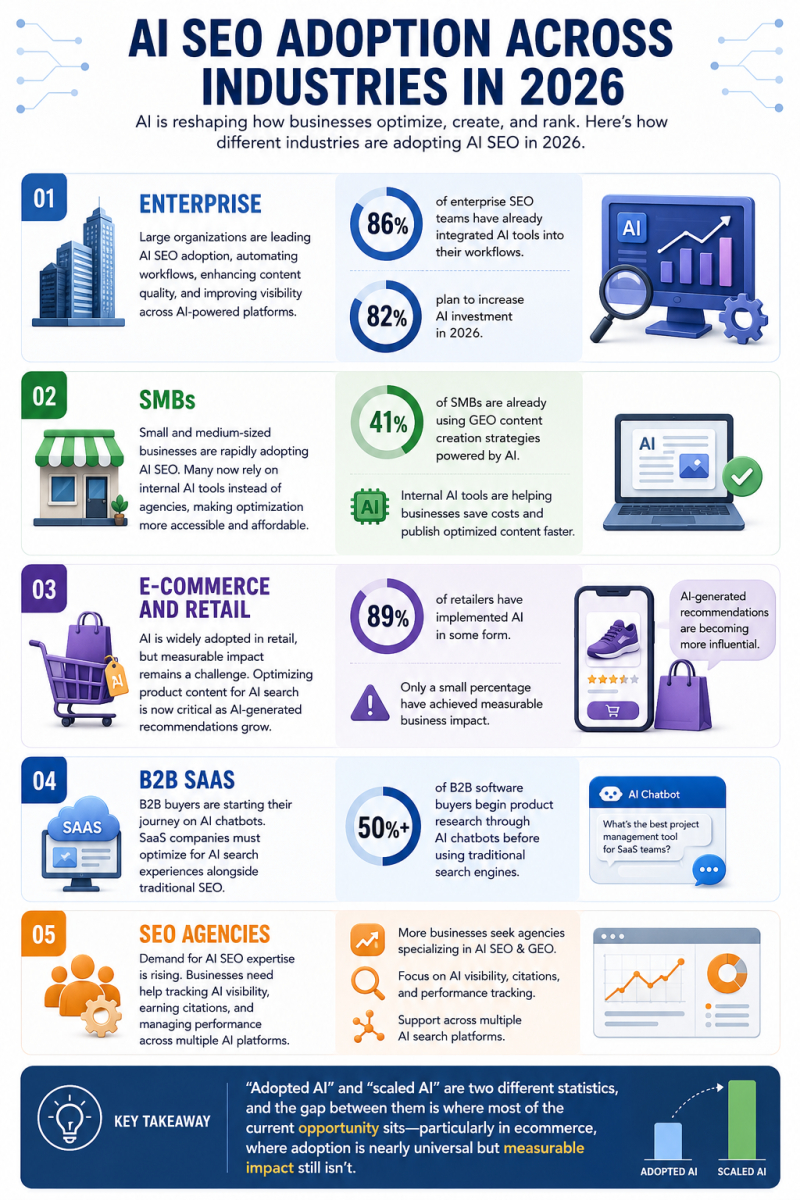
Finding 5: Users Have Already Moved. Analytics Haven't Caught Up.
- 77% of U.S. users report using ChatGPT as a search engine, not just a chatbot.
- 83% of AI usage happens inside mobile apps rather than desktop browsers on some platforms which means standard web analytics tools can significantly undercount real AI search activity.
- 65%+ of Gen Z say they'd rather ask an AI assistant for product recommendations than browse traditional search results.
- 1 in 4 B2B buyers now use generative AI more than traditional search when researching suppliers.
- AI referral traffic converts at roughly 7.1% close to paid search (7.8%) and about 2.5x standard Google organic.
Users increasingly treat AI answers as a starting point for research-heavy or comparison queries, while navigational and transactional searches checking a known brand's site, logging into an account still drive clicks straight to the open web. The split matters: it tells you which query types are worth optimizing for clicks versus which are worth optimizing purely for citation.
Key takeaway: If your analytics stack only measures browser sessions, you're likely undercounting AI-driven discovery significantly, especially on mobile. Brand mention tracking and AI citation tracking exist specifically to fill that blind spot.
Finding 6: What Actually Gets Content Cited
Ranking and citation are correlated but not identical, and AI systems appear to weight a different mix of signals than classic Google ranking:
1) Topical Authority
AI search engines prefer websites that cover a subject in depth rather than publishing isolated keyword-focused pages. Building comprehensive content around related topics helps establish expertise and improves the chances of being cited in AI-generated results.
2) E-E-A-T Signals
Experience, Expertise, Authoritativeness, and Trustworthiness (E-E-A-T) are essential for AI SEO, especially for Your Money or Your Life (YMYL) topics. AI systems are more likely to reference content from credible sources with proven expertise.
3) Entity SEO and Structured Data
Schema markup and entity-based SEO help AI systems understand what your content, business, products, and people represent. Proper structured data improves content interpretation and increases visibility in AI-powered search experiences.
4) Third-Party Citations
AI search platforms frequently reference trusted third-party websites instead of brand-owned content. Earning mentions from authoritative publications, industry websites, and trusted resources improves credibility and increases the likelihood of being cited in AI-generated answers. That's also where link building enters the AI SEO picture: a verified roundup of link building statistics puts the correlation between branded web mentions and AI Overview visibility at 0.664, versus 0.218 for backlinks.
5) Content Clarity
Content should provide direct answers using clear headings, concise explanations, and well-organized formatting. AI systems can extract information more accurately from structured, easy-to-read content than from lengthy or unclear paragraphs.
6) Freshness
Regularly updating content with recent statistics, verified information, and current industry trends helps maintain relevance. AI search engines often prioritize fresh, accurate information when generating responses.
7) Crawlability
AI crawlers such as GPTBot, PerplexityBot, Google-Extended, and ClaudeBot must be able to access your website. Proper technical SEO, crawl settings, and indexable content ensure AI systems can discover and use your information effectively.
Key takeaway: Most AI citations for unbranded queries don't come from your own website. If your authority-building budget is entirely on-page, you're optimizing for less than half of what actually decides whether you get cited.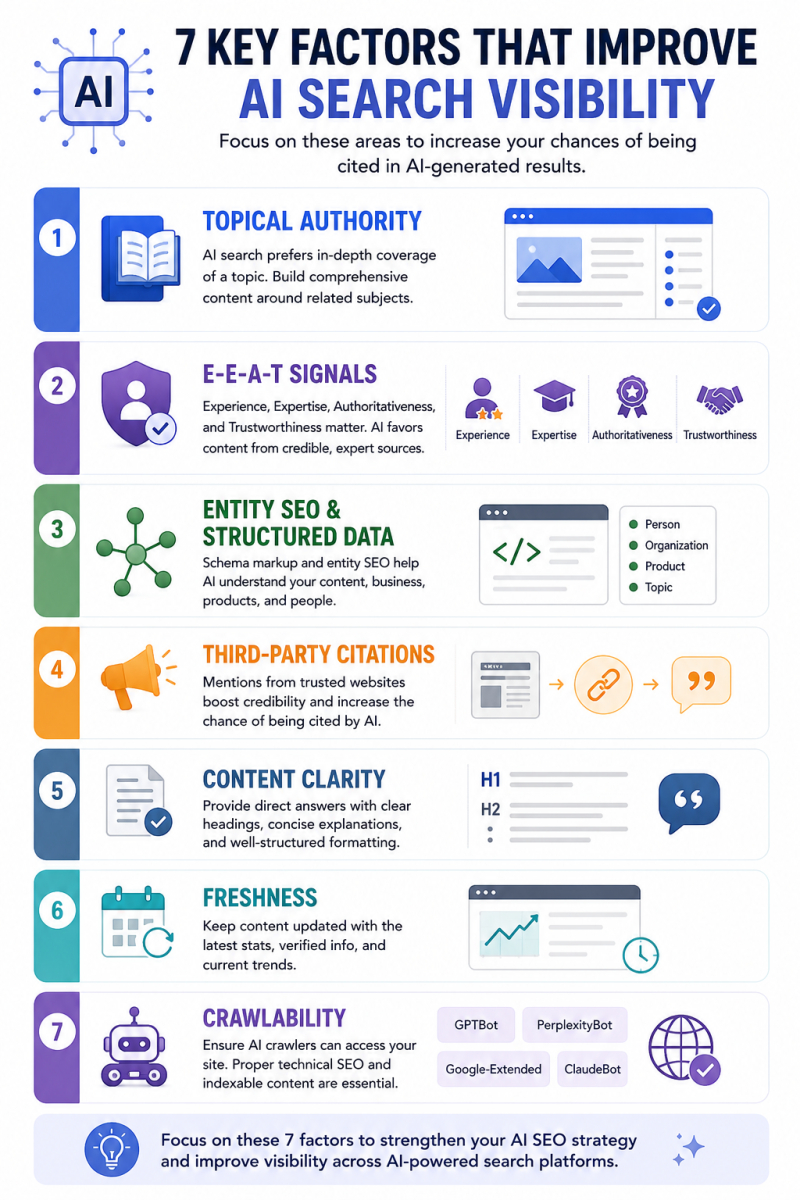
Finding 7: How Businesses Are Actually Responding
The teams gaining ground in 2026 aren't doing something radically new they're being more deliberate about the fundamentals, applied to a wider set of surfaces:
- Audit current AI visibility first. Check whether a brand is currently cited in Google AI Overviews, AI Mode, ChatGPT search, and Perplexity AI search for its core queries before optimizing anything.
- Invest in topical clusters, not single keyword pages. Depth is what earns citation-worthy authority.
- Add structured data across the board product, article, FAQ, and organization schema so AI systems can parse and cite content accurately.
- Build off-site presence deliberately. Since most AI citations for unbranded queries come from third-party sources, digital PR and community presence are now part of the same signal set as on-page SEO, not a separate budget line.
- Choose SEO content optimization tools built for citation, not just keyword density. Modern SEO content optimization tools increasingly track entity coverage and AI-citation likelihood, not just keyword placement.
- Be selective with the best AI writing tools. The best AI writing tools for this environment are the ones that help produce clearly structured, well-cited, answer-first content not the ones that simply generate volume.
- Don't overlook the CMS layer. A lot of this work runs through digital marketing WordPress tools and plugins that already handle schema markup and structured formatting at scale most teams just aren't configuring them for AI retrieval yet.
- Report on both layers. Combine rank tracking with AI citation tracking so reporting reflects the full SERP visibility picture, not just the shrinking organic-click portion of it.
Key takeaway: None of this requires a rebuilt strategy it requires redirecting the same SEO fundamentals (authority, structure, technical health) toward citation as a measurable outcome, not just rank.
Finding 8: The Myths Slowing Teams Down
A few common SEO myths are actively costing teams ground in 2026:
- "Traditional SEO doesn't matter anymore." It's still the foundation GEO is built on structured data and topical authority are prerequisites for citation, not replacements for it.
- "More content always wins." The data says the opposite: topical depth and citation-worthiness outperform volume. AI systems favor a smaller set of clearly structured, third-party-validated pages over a large volume of thin ones.
- "AI Overviews only hurt publishers." Cited brands see meaningfully higher CTR on adjacent organic listings than uncited ones on the same query the two are additive, not purely extractive.
- "If it ranks, it'll get cited." Ranking is a prerequisite for citation, not a guarantee. Content that hedges or buries its conclusion can rank while never being pulled into an AI-generated answer.
Beyond the myths, the practical barriers are consistent across surveys: lack of budget is the most cited obstacle to GEO adoption despite documented ROI, and only about a third of teams have formally trained staff on GEO-specific tactics even though trained teams show a meaningfully higher performance gap over untrained ones.
Key takeaway: The biggest challenge in AI SEO right now isn't technical it's organizational. Budget and training gaps, not algorithm complexity, are what's holding most teams back from converting AI adoption into measurable visibility.
Finding 9: Where This Goes Next
- Gartner projects traditional organic search volume could decline 25% by 2026, with some extended forecasts suggesting an even steeper drop as AI-mediated search matures.
- The U.S. GEO software market is projected to reach $365.4 million in 2026, growing at a 42.9?GR early-stage but compounding quickly.
- Google has said AI Mode query volume is more than doubling each quarter, gradually shifting more research-intent queries into a fully conversational format.
- Video and multimodal content are being pulled into AI citations more often short, timestamped, chaptered video is increasingly treated as a citable source alongside text.
- Expect continued fragmentation among AI search engines rather than one dominant winner ChatGPT's referral share has already slipped from the mid-80s to the high-70s (percent) as Gemini, Perplexity, Copilot, and Claude pick up share.
Key takeaway: None of these trends are reversing. The direction is consistent even where the exact pace varies by source which means the businesses building AI visibility measurement now will have a multi-quarter head start over the ones that wait for the picture to fully settle.
Trend Snapshot: AI Search Adoption Timeline (2025–2026)
|
Period |
AI Overview Prevalence |
Zero-Click Rate (US) |
Organic CTR Impact |
ChatGPT Referral Share |
|
Early 2025 |
~31% of tracked queries |
~58–60% |
Baseline |
~84.2% |
|
Mid-2025 |
~35–40% |
~62–64% |
CTR down ~50%+ on AIO queries |
~85–89% |
|
Late 2025 |
~45% |
~65% |
CTR floor at 0.61% (from 1.76%) |
~78–80% |
|
Early 2026 |
~47–48% |
~68.01% |
Partial rebound to ~2.4% for cited brands |
~76.85% |
Directional averages compiled from BrightEdge, Seer Interactive, SparkToro/Similarweb, and StatCounter. Individual studies vary by methodology and query mix the defensible range for AI Overview prevalence spans roughly 25–50?pending on the panel.
What This Means for Your AI SEO Strategy
- Fix measurement first. If rankings are stable but traffic is dropping, don't chase a phantom ranking problem add citation tracking and brand mention monitoring alongside your existing analytics.
- Rebalance content investment. Commercial-intent pages still drive direct clicks; informational content increasingly earns citations instead. Fund both, but stop measuring them the same way.
- Write to be extractable. A page needs a clear, quotable answer an AI system can lift cleanly not just comprehensive coverage.
- Treat off-site authority as part of SEO, not separate from it. Most AI citations for unbranded queries come from outside your own domain.
- Don't chase every SERP feature. Feature-specific tactics have a short shelf life; durable signals clarity, authority, structured data survive every format change Google or the AI platforms make next.
Key Takeaways
- AI Overviews now trigger on roughly 48% of tracked Google queries, up from ~31% a year ago.
- 68%+ of U.S. Google searches now end without a click zero-click search is no longer the exception, it's the baseline.
- Organic CTR on AI Overview queries fell as low as 0.61?fore partially recovering to 2.4% for cited brands being cited now matters more than ranking #1.
- 86% of enterprise SEO teams have integrated AI into their workflow; only a fraction have built real measurement systems for AI visibility.
- GEO and traditional SEO are not competing disciplines they run on the same foundation, and citation is largely additive to ranking.
- 51% of B2B software buyers now start research in an AI chatbot more often than Google a front-door shift most SEO for SaaS companies strategies haven't caught up to.
- The biggest 2026 gap isn't strategy it's measurement. Most teams say they're targeting AI search visibility; far fewer can actually prove it's working.
Frequently Asked Questions
1) What Is AI SEO?
AI SEO is the process of optimizing content to appear in AI-powered search experiences such as Google AI Overviews, ChatGPT Search, Perplexity, and other generative search engines. It focuses on earning citations and visibility in AI-generated answers, not just traditional search rankings.
2) Is AI SEO the Same as Generative Engine Optimization (GEO)?
Yes, AI SEO and Generative Engine Optimization (GEO) refer to the same concept. GEO is the formal industry term, while AI SEO is the more commonly used name for optimizing content for AI-generated search results.
3) How Often Do Google AI Overviews Appear?
Google AI Overviews now appear for a large percentage of informational search queries. While exact figures vary by study and industry, their presence continues to grow as Google expands AI-powered search experiences.
4) Do AI Overviews Really Reduce Website Traffic?
AI Overviews can reduce traditional organic click-through rates because users often receive answers directly on the search page. However, websites cited within AI Overviews typically receive greater visibility and higher-quality traffic than those not referenced.
5) What Is a Zero-Click Search?
A zero-click search occurs when users receive the information they need directly from the search results without visiting a website. AI Overviews, featured snippets, and knowledge panels are common examples of zero-click experiences.
6) Which AI Search Engine Has the Largest Market Share?
ChatGPT remains one of the leading AI search platforms in terms of user adoption and referral traffic. At the same time, competitors such as Google Gemini, Perplexity, Microsoft Copilot, and Claude continue expanding their market presence.
7) How Can a Business Track AI Search Visibility?
Businesses can monitor AI search visibility by combining traditional SEO tools with AI citation tracking solutions. These tools measure brand mentions and citations across AI search engines and AI-generated search responses.
8) Are AI SEO and Traditional SEO Competing Priorities?
No, AI SEO builds on the foundation of traditional SEO rather than replacing it. Strong technical SEO, structured data, high-quality content, and topical authority remain essential for achieving visibility in AI search.
9) Which Industries Are Most Affected by AI Search?
Industries such as B2B SaaS, e-commerce, healthcare, finance, and technology are experiencing significant changes due to AI-powered search. Businesses in these sectors are increasingly optimizing content for AI-generated search experiences.
10) Does Structured Data Affect AI Search Visibility?
Yes, structured data helps AI systems understand website content more accurately. Proper schema markup improves the chances of content being recognized, cited, and displayed in AI-generated search results.
11) What Is the Most Common AI SEO Mistake?
The biggest mistake is focusing only on publishing large amounts of content instead of creating authoritative, well-structured, and trustworthy information. AI search engines prioritize content quality, expertise, and citation value over content volume.
.jpg)