
.jpg "Website Design Matters")
A website is often the very first conversation a small business has with a future customer, and that conversation happens in milliseconds. Long before someone reads a headline or scrolls to a product page, they have already formed an opinion about whether your business feels trustworthy, current, and worth their time. This is why website design for small businesses has moved from a "nice to have" to one of the most important growth levers available today. Whether you manage the process in-house, work with a freelancer, or partner with one of the top web development companies in USA, understanding how design shapes perception, engagement, and revenue is essential before you build or redesign a single page. In this guide, we'll walk through the latest website design statistics, the trends defined by website design trends 2026, and the practical steps small businesses can take to turn their website into a genuine growth engine.
In 2026, website design has a measurable impact on small business success, with data showing that 83% of small businesses now have a website, up from just 64% in 2018, as design tools have become more accessible. Research shows that 94% of first impressions are tied directly to website design, and 81% of shoppers research a business online before making a purchase. Businesses with professionally designed websites see roughly 50% more revenue on average, while 88% of online shoppers say they won't return to a site after a poor experience. Mobile behavior also shapes these numbers, since 63% of all website traffic now comes from mobile devices, making responsive design essential rather than optional. Together, these percentages show that website design isn't just a visual choice for small businesses it's a measurable driver of trust, traffic, and revenue.
The Growing Importance of Website Design for Small Businesses
A professional website has become one of the most important assets for small businesses looking to build credibility and attract new customers. In today’s digital-first world, customers often search online before making purchasing decisions. A well-designed website helps businesses create a strong first impression, showcase their products or services, and establish trust with potential customers. Modern website design goes beyond visual appearance. Small businesses need websites that are fast, mobile-friendly, easy to navigate, and optimized for search engines. A user-friendly design improves customer experience by helping visitors quickly find important information, explore offerings, and take actions such as making a purchase, booking a service, or contacting the business.
With increasing competition across industries, website design plays a major role in helping small businesses stand out from competitors. A customized website that reflects a brand’s identity, values, and unique selling points can create stronger customer connections and improve brand recognition. Businesses that invest in quality web design are more likely to build long-term relationships with their audience. Website design also directly impacts online visibility and business growth. Search engines consider factors such as page speed, mobile responsiveness, and user experience when ranking websites. By following modern design practices and SEO strategies, small businesses can improve their search rankings, attract more organic traffic, and generate better leads.
Latest Website Design Statistics Every Small Business Should Know
If you're still on the fence about investing in your site, the numbers make a compelling case. These website design statistics are drawn from recent industry research and cover everything from first impressions to mobile behavior and conversion impact.
How Many Users Judge a Business by Its Website
Recent industry research consistently finds that roughly 94% of a visitor's first impression of a website is tied to design elements like layout, color, and imagery rather than copy. A widely cited Stanford study found that around 75% of users judge a company's overall credibility based on its website design alone, and about half of consumers say their impression of a business depends directly on how its website looks and functions.
Mobile Website Usage Statistics
Mobile devices now account for roughly 47% of web traffic in the United States, and globally more than nine in ten internet users go online at least partly through a mobile device. That means a website that isn't built with mobile-friendly website design in mind is turning away a huge share of potential customers before they even see an offer.
Conversion Rate Impact of Good UX Design
The financial case for user experience (UX) design is one of the strongest in digital marketing. Forrester research often cited across the industry estimates that every $1 invested in UX design returns roughly $100 in value, and that well-designed interfaces can lift conversion rates by up to 200%, with a fully optimized experience pushing that figure toward 400%. Separate research from McKinsey has found that design-led companies tend to grow revenue roughly twice as fast as their industry peers.
Page Speed and User Retention
Speed and retention are closely linked. Industry data shows that a delay of just one second in page load time can reduce conversions by around 7%, and a ten-second delay can increase bounce rate by well over 100%. Depending on the study, somewhere between 40% and 60% of visitors will abandon a page entirely if it takes more than a few seconds to load, which makes website loading speed one of the highest-leverage fixes a small business can make.
|
Statistic |
What It Means for Your Business |
|
About 94% of first impressions are design-related |
Visual design shapes trust before a visitor reads any content |
|
Roughly 75% of users judge credibility by website design |
An outdated layout can undercut an otherwise strong brand |
|
Around 88% of users won't return after a poor experience |
Bad website user experience directly costs repeat business |
|
Roughly 8 in 10 small businesses now operate a website |
Going without one is an increasing competitive disadvantage |
|
About 47% of U.S. web traffic is mobile |
Mobile-friendly website design is no longer optional |
|
Responsive design can lift conversions by around 11% |
Responsive website design pays for itself in customer actions |
|
A 1-second load delay can cut conversions by ~7% |
Website loading speed has a direct line to revenue |
|
Every $1 in UX can return roughly $100 (Forrester) |
Professional website design is one of the highest-ROI investments |
|
Nearly 95% of websites fail basic accessibility checks |
Website accessibility remains an overlooked opportunity and risk |
|
Small business sites typically cost $5,000–$10,000 |
Budgeting properly avoids costly redesigns down the road |
How Professional Website Design Builds Brand Trust and Credibility
In today's digital-first marketplace, a website is often the very first interaction a customer has with a brand, making professional website design a critical factor in shaping perception. A cluttered, outdated, or slow-loading site can instantly signal unreliability, while a clean, well-structured design communicates competence and attention to detail before a visitor even reads a single word of content. This is why businesses increasingly turn to the Top Web Development Companies in USA to ensure their digital presence reflects the same professionalism and quality they offer in their products or services. A polished website acts as a silent salesperson, building an immediate sense of legitimacy that encourages visitors to stay, explore, and eventually convert into customers.
Beyond first impressions, professional design plays a deeper role in establishing ongoing trust through usability, consistency, and security. Elements like intuitive navigation, mobile responsiveness, fast load times, and clear calls-to-action all contribute to a seamless user experience that keeps visitors engaged rather than frustrated. When a website is easy to use and free of broken links or design inconsistencies, it reinforces the idea that the brand behind it is dependable and detail-oriented. This is precisely the value that the Top Web Development Companies in USA bring to the table they understand how to blend aesthetics with functionality so that every interaction reinforces credibility rather than undermining it.
Ultimately, brand trust is built cumulatively, and a professionally designed website serves as the foundation upon which that trust is earned over time. Consistent branding, secure payment gateways, transparent contact information, and well-crafted content all work together to reassure visitors that they're dealing with a legitimate, established business rather than a fly-by-night operation. Companies that invest in expert design services, particularly those partnering with the Top Web Development Companies in USA, position themselves to stand out in competitive industries while fostering long-term customer loyalty. In an era where consumers make snap judgments based on digital experiences, professional website design isn't just a nice-to-have it's a strategic necessity for building lasting brand credibility.
The Impact of Website Design on Customer Experience and Engagement
Website design and customer experience (CX) are deeply intertwined. A visually appealing site that's confusing to use will still lose customers, while a simple site that's genuinely easy to navigate can outperform flashier competitors.
What Website User Experience Really Means
Website user experience covers everything from how quickly a page loads to whether a visitor can find pricing, contact details, or a product without hunting for them. Strong UX design removes unnecessary steps, minimizes distractions, and guides visitors toward the action a business wants them to take.
Reducing Bounce Rate With Better Design
Poor experiences drive people away fast. Roughly 88% of users say they won't return to a website after a bad experience, and unclear navigation or slow-loading pages are among the top reasons visitors leave without taking any action. Improving core UX elements clear headings, logical page structure, and fast load times has a measurable effect on how long visitors stay and how many convert.
How Responsive Website Design Helps Small Businesses Reach More Customers
Responsive website design ensures a single website adapts cleanly to desktops, tablets, and smartphones, rather than forcing a business to maintain separate versions of its site.
What Responsive Website Design Actually Does
Instead of a fixed layout, a responsive site uses flexible grids and breakpoints so that images, menus, and text resize and rearrange automatically depending on screen size. This means a visitor browsing on a phone gets a layout built for thumbs and small screens, while a desktop visitor sees a layout suited to a mouse and a larger display.
The Business Case for Mobile-Friendly Website Design
The numbers back this up clearly: websites with responsive design report conversion rates roughly 11% higher and engagement around 20% higher than non-responsive sites, and a majority of businesses that switch to a mobile-responsive layout report an increase in sales afterward. Since close to half of all U.S. web traffic now comes from mobile devices, mobile-friendly website design has shifted from a technical detail to a core business requirement.
Mobile-First Website Design Trends Shaping Business Growth
Mobile-first web design flips the traditional process: instead of designing for desktop and adapting down, designers start with the smallest screen and build up.
Why Mobile-First Web Design Matters in 2026
With mobile devices driving such a large share of traffic and search engines factoring mobile experience into rankings, mobile-first design has become the default approach for any modern business website development project. Starting with mobile constraints forces simpler navigation, larger touch targets, and more focused content all of which tend to improve the desktop experience as well.
Mobile-First Design Best Practices
Effective mobile-first sites prioritize a single clear call-to-action per screen, compress images and code for faster loading, use collapsible menus to save space, and test forms and checkout flows specifically on smaller screens where thumb-typing and tap accuracy matter most.
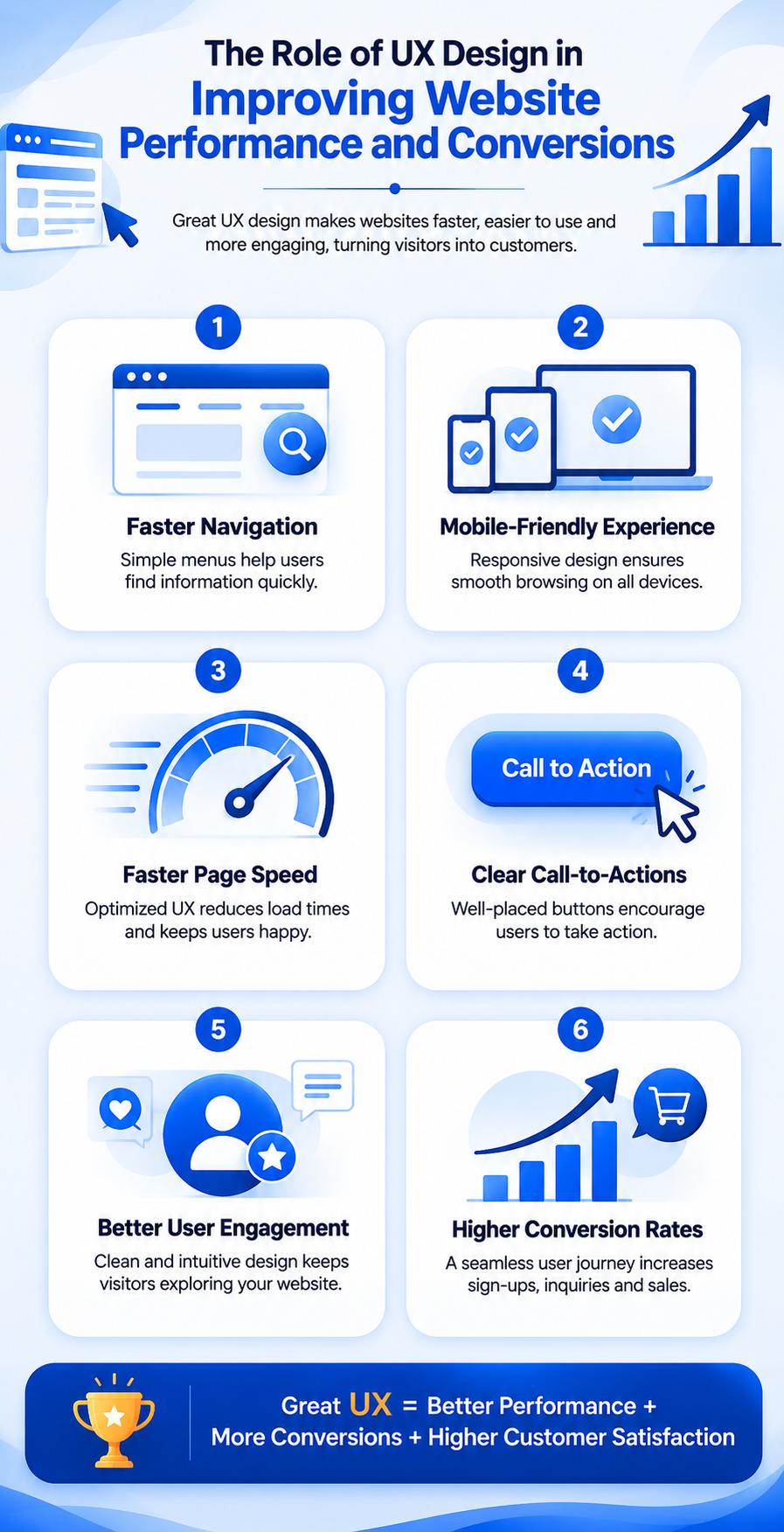
The Role of UX Design in Improving Website Performance and Conversions
User experience (UX) design is the discipline behind why some websites convert visitors into customers far more consistently than others.
Top Website Design Trends Small Businesses Should Follow in 2026
Website design trends 2026 are shaped by three forces: artificial intelligence, mobile-first behavior, and rising expectations around accessibility and performance. A few trends stand out:
- AI-powered website personalization, one of the defining modern web design trends of the year, with sites increasingly adjusting content, product recommendations, and even layout in real time based on a visitor's behavior and history, rather than showing every visitor the same static homepage.
- Minimalist website layouts with generous white space, which continue to dominate partly because they load faster and partly because they keep visitor attention focused on key messages instead of competing with unnecessary decoration.
- Interactive website elements such as subtle animations, scroll-triggered effects, and interactive product configurators, which help sites feel modern and engaging without the heavy page weight of older, flash-style features.
- Voice search optimization, as voice assistants and conversational search become more common, pushing businesses to write content in a natural, question-and-answer style that matches how people actually speak their queries.
- Accessibility-focused design, including high-contrast color palettes, screen-reader support, and keyboard navigation, which has moved from a compliance checkbox to a mainstream design principle.
|
Trend |
Why It Matters for Small Businesses |
|
AI-powered personalization |
Tailors content and offers to each visitor's behavior in real time |
|
Mobile-first, responsive design |
Matches how the majority of customers now browse and shop |
|
Minimalist, functional layouts |
Cuts clutter, speeds up load times, and highlights key actions |
|
Voice search and voice navigation |
Prepares a site for hands-free, conversational search behavior |
|
Accessibility-first design (WCAG-aligned) |
Lowers legal risk while reaching a much broader customer base |
|
Interactive micro-animations |
Boosts engagement without adding heavy page weight |
|
Sustainable, lightweight code |
Leaner sites load faster and cost less to host |
|
Conversational AI chatbots |
Provides instant answers and support around the clock |
How AI Is Transforming Modern Website Design Experiences
Artificial intelligence has quietly become one of the most influential forces behind modern web design trends, changing not just how sites are built but how they behave once they're live.
AI Chatbots and Virtual Assistants
AI-driven chatbots now handle everything from answering basic questions to qualifying leads and booking appointments, giving small businesses a way to offer round-the-clock customer experience (CX) support without needing a full-time staff member monitoring a chat window.
AI-Driven Content Personalization
Beyond chat, AI tools help websites adjust headlines, product suggestions, and even page structure based on visitor behavior, effectively giving each visitor a version of the site tailored to their interests something that would have required a large development team just a few years ago.
Why Website Speed and Performance Matter for Business Websites
Website performance optimization is one of the few improvements that benefits every part of a business website at once: user experience, search rankings, and conversions.
Website Loading Speed Statistics
Load times remain a persistent problem industry-wide, with average desktop and mobile load speeds still well above the two-to-three-second window most visitors expect. Since a large share of visitors will leave a page that takes too long to load, and every additional second of delay measurably reduces conversions, loading speed is one of the most cost-effective areas for a small business to improve.
Website Performance Optimization Tips
Practical steps include compressing and properly sizing images, minimizing unnecessary scripts and plugins, using a content delivery network, enabling browser caching, and choosing reliable, fast hosting. None of these require a full redesign, which makes performance one of the easiest wins available to any business website.
Essential Features Every Small Business Website Needs
Regardless of industry, certain features consistently separate websites that perform well from those that quietly lose customers:
- Fast loading speed: a site that loads in a couple of seconds keeps far more visitors engaged than one that takes five or ten seconds, directly protecting the traffic a business has already earned through marketing and search.
- Clear navigation: website navigation best practices call for a simple, predictable menu structure, a visible search function where relevant, and a logical page hierarchy so visitors and search engines can find information without confusion.
- Contact forms and CTAs: clear calls-to-action and easy-to-find contact forms turn passive visitors into leads by making it obvious what a visitor should do next, whether that's calling, emailing, or requesting a quote.
- SEO-friendly structure: a search engine optimization (SEO) friendly website uses clean code, descriptive page titles, proper heading structure, and fast-loading pages, all of which help search engines understand and rank content appropriately.
- Secure website hosting: an SSL certificate, regular backups, and secure hosting protect both customer data and business reputation, and are increasingly treated as a baseline trust signal by both visitors and search engines.
- Mobile responsiveness: a site that performs well on phones and tablets isn't optional anymore; it's a core requirement for reaching the majority of today's web traffic.
How SEO-Friendly Website Design Improves Online Visibility
Website design and search engine optimization aren't separate disciplines they overlap significantly, and a poorly structured site can undermine even a strong content and marketing strategy.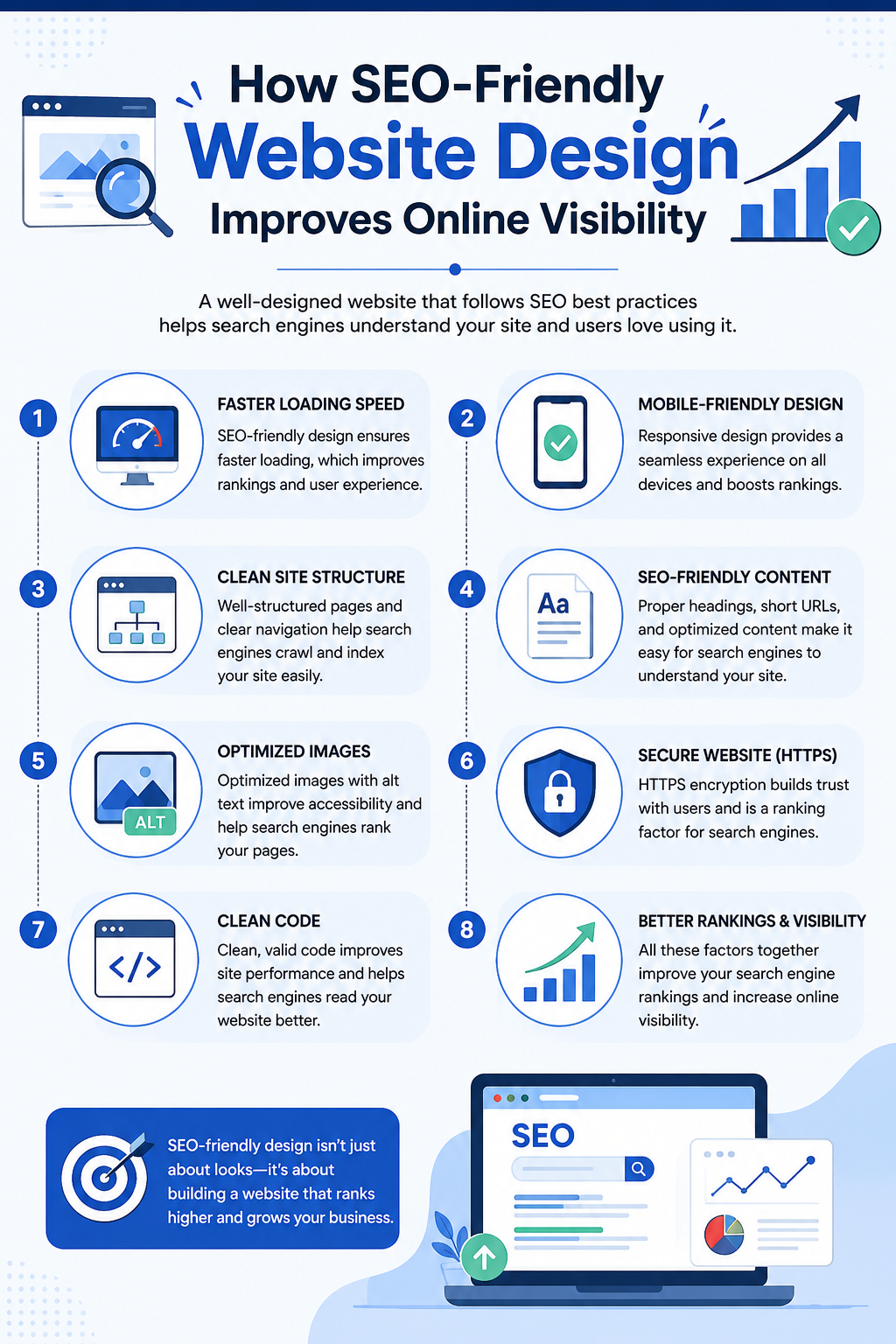
Common Website Design Mistakes Small Businesses Should Avoid
Even well-intentioned website projects can undercut their own results with a handful of recurring mistakes.
Cluttered Layouts and Poor Navigation
Overcrowded pages, too many competing calls-to-action, and confusing menus all increase the mental effort required to use a site, pushing visitors toward the back button instead of a purchase.
Ignoring Mobile Users
Sites that were designed only with desktop in mind often break down badly on phones, with tiny text, unusable menus, or images that don't resize, all of which push away close to half of potential visitors.
Slow-Loading Pages and Bloated Code
Oversized images, excessive plugins, and unoptimized code are among the most common and most fixable reasons a site underperforms, quietly costing a business both visitors and search ranking.
The Benefits of Investing in Professional Website Design Services
Beyond the process itself, it's worth stepping back to look at what professional website design actually delivers for a small business once the site is live.
1) Stronger Brand Credibility and Customer Trust
A professionally designed website helps small businesses build trust by presenting their brand, reviews, testimonials, and certifications in a polished and organized way. A modern, user-friendly website creates a stronger first impression compared to outdated or poorly structured websites.
2) Increased Lead Generation and Sales Opportunities
A well-designed website improves conversions by using clear calls-to-action, optimized landing pages, and simple navigation paths. These elements help turn more visitors into leads and customers without requiring additional advertising investment.
3) A Competitive Edge in a Crowded Market
A custom and visually appealing website helps businesses stand out from competitors using generic templates. A strong online presence can influence visitors when they compare multiple brands and decide which company to choose.
4) Cost-Effective Website Design Solutions for Small Businesses
Affordable website design does not mean compromising on quality. Small businesses can choose from flexible options such as tiered packages, phased development, and customized templates that provide professional results while staying within budget.
5) Long-Term ROI of Professional Website Design
Investing in professional website design can deliver long-term value by continuously generating leads, improving customer engagement, and supporting business growth. A well-built website often continues producing results long after the initial launch.
6) Website Accessibility Trends for Better User Experiences
Website accessibility is becoming an essential part of modern web design as businesses focus on creating inclusive digital experiences. Accessible websites allow more users to interact with content while improving usability for everyone.
7) Why Accessibility Is a Legal and Business Priority
Accessibility is not only about inclusivity but also about reducing legal and business risks. Many websites still fail accessibility standards, and proactive improvements can help businesses avoid costly legal issues while building a better user experience.
8) Practical Accessibility Best Practices
Following accessibility guidelines like WCAG helps businesses create websites that are easier to use for all visitors. Best practices include adding image alt text, improving color contrast, supporting keyboard navigation, and testing compatibility with screen readers.
The Connection Between Website Design and Lead Generation
For most small businesses, a website's real job isn't just to look good; it's to generate leads.
Optimizing Landing Pages for Leads
Landing pages built specifically around a single offer, with a clear headline, supporting content, and one obvious action, consistently outperform general pages that try to do everything at once.
Using CTAs Effectively
Calls-to-action work best when they're specific, visible without excessive scrolling, and repeated at natural points throughout a page, rather than buried once at the very bottom where many visitors never reach.
Future Website Design Trends That Will Impact Small Businesses
Looking beyond this year, a few emerging patterns are likely to shape business website development for the next several years.
Voice and Visual Search
As voice assistants and image-based search tools become more capable, websites that structure content clearly and use descriptive, well-tagged imagery will have an advantage in showing up across these newer discovery channels.
Sustainable and Ethical Web Design
Lightweight, energy-efficient websites that avoid manipulative "dark pattern" design are gaining attention both as a genuine ethical stance and as a practical way to improve performance and user trust simultaneously.
How Small Businesses Can Create a Competitive Online Presence
Small business online presence isn't built through design alone, but design is usually the foundation everything else stands on.
Choosing the Right Web Development Partner
Whether a business hires a freelancer, an in-house designer, or an agency, the right partner should understand both the visual and technical sides of a project: branding, UX design, page speed, and SEO-friendly structure all need to work together.
Why Businesses Turn to Top Web Development Companies in USA
Many small businesses eventually outgrow DIY builders and turn to top web development companies in USA for custom website design, ongoing technical support, and strategic guidance on everything from e-commerce website setup to content management system (CMS) selection. When comparing options, it's worth looking at a company's portfolio, industry experience, transparency around pricing and timelines, and whether they offer support after launch rather than disappearing once the site goes live.
The Website Design Process: From Concept to Launch
Understanding how a website actually comes together helps small business owners set realistic timelines, budgets, and expectations before a project starts, whether the work is handled in-house, by a freelancer, or by one of the top web development companies in USA.
1) Discovery and Research
Every successful website project begins with understanding business goals, target audiences, competitors, and required features. This research phase helps create a clear strategy and prevents future redesigns by ensuring the website is built around actual business needs.
2) Planning, Sitemap, and Wireframing
After defining goals, teams create a sitemap that outlines the website structure and required pages. Wireframes then provide a basic layout of each page, helping businesses improve navigation and content organization before visual design begins.
3) Visual Design and Branding
During the visual design phase, designers apply brand elements such as colors, typography, images, and layouts to create a unique identity. Custom design choices help businesses stand out from competitors and deliver a memorable user experience.
4) Development and CMS Integration
Developers transform approved designs into a fully functional website by creating pages, forms, features, and integrations. A content management system (CMS) is also integrated, allowing business owners to easily update website content without technical assistance.
5) Testing and Quality Assurance
Before launching, the website goes through detailed testing to check speed, mobile responsiveness, browser compatibility, forms, links, and overall functionality. Quality assurance ensures visitors receive a smooth and error-free browsing experience.
6) Launch, Maintenance, and Ongoing Optimization
Launching the website is only the beginning of the process. Continuous monitoring, security updates, content improvements, analytics tracking, and performance optimization help maintain website effectiveness and support long-term business growth.
How Modern Website Design Supports Business Growth
Ultimately, website design decisions ladder up to concrete business outcomes.
Your Website as a 24/7 Sales Tool
A well-designed website works continuously, answering questions, capturing leads, and even completing sales at any hour, without the constraints of staffed business hours.
Building Long-Term Customer Relationships
Beyond the first transaction, thoughtful design easy account management, clear support information, and consistent branding helps turn one-time buyers into repeat customers who trust a business enough to return.
Final Thoughts: Why Website Design Is a Key Business Investment
The evidence is consistent across nearly every recent study: website design statistics every business owner should know all point in the same direction. First impressions, trust, mobile behavior, page speed, and accessibility are no longer separate concerns they're all part of one connected system that determines whether a visitor becomes a customer. For small businesses, this means website design for small businesses deserves the same strategic attention as pricing, staffing, or product decisions. Whether that means refreshing an outdated site, prioritizing mobile-first design, or partnering with one of the top web development companies in USA for a full custom build, the businesses that treat their website as a growth investment rather than a one-time expense are the ones best positioned to compete in 2026 and beyond.
Frequently Asked Questions
1) Why Is Website Design Important for Small Businesses?
Website design creates the first impression of a business, builds trust, and influences whether visitors stay and take action. For small businesses competing with larger brands, a professional website helps establish credibility and attract more customers.
2) What Percentage of Small Businesses Have a Website?
Industry research shows that around three-quarters to over 80% of small businesses have a website. This number continues to grow as website builders and professional design services become more affordable and accessible.
3) How Does Website Design Affect SEO?
Website design and SEO work together to improve online visibility. Factors such as page speed, mobile responsiveness, clean code, and proper heading structure help search engines understand and rank websites, while poor design can negatively impact rankings.
4) What Is Responsive Website Design and Why Does It Matter?
Responsive website design allows a website to automatically adjust its layout across desktops, tablets, and mobile devices. It improves user experience, increases engagement, and helps businesses reach the growing number of users browsing through smartphones.
5) How Much Does Professional Website Design Cost for a Small Business?
The cost of professional website design depends on factors like complexity, features, and customization requirements. Small business websites usually range from a few thousand dollars to around $10,000, while e-commerce and advanced websites may require a higher investment.
6) What Are the Biggest Website Design Trends in 2026?
Major website design trends in 2026 include AI-powered personalization, mobile-first design, minimalist layouts, voice search optimization, and accessibility-focused experiences. These trends help businesses create faster, smarter, and more user-friendly websites.
7) How Does UX Design Improve Website Conversions?
UX design improves conversions by making websites easier to navigate and reducing barriers in the customer journey. Better layouts, faster loading speeds, clear calls-to-action, and simple navigation help increase engagement and generate more leads.
8) What Website Design Mistakes Should Small Businesses Avoid?
Small businesses should avoid cluttered layouts, slow-loading pages, poor mobile experiences, unclear calls-to-action, and complicated navigation. These issues can increase bounce rates and prevent visitors from becoming customers.
9) How Do I Choose the Right Web Development Company?
Choosing the right web development company requires evaluating their portfolio, industry experience, pricing transparency, communication process, and post-launch support. Comparing multiple providers helps businesses find a reliable partner for long-term success.
10) How Often Should a Small Business Redesign Its Website?
Most businesses should consider a major website redesign every two to three years to keep up with technology, user expectations, and design trends. Regular updates to content, performance, and security should continue throughout the website's lifecycle.
.jpg)